
Top 5 Best-Selling Midsize Jets in the World
In the competitive world of business aviation, midsize jets occupy a critical position, offering an ideal balance of range, comfort, and operational economics. For private jet buyers, charter clients, and corporate flight departments, selecting the right midsize jet requires careful consideration of performance capabilities, cabin amenities, and long-term value.
This comprehensive guide examines the top five best-selling midsize business jets based on global sales figures, operational efficiency, and passenger satisfaction. Whether you’re in the market to purchase, exploring charter options, or interested in business aviation, this analysis will provide valuable insights into the industry’s most successful mid-size jet platforms.

The sleek profile of a modern midsize business jet represents the pinnacle of aviation engineering and luxury travel.
Understanding the Midsize Jet Market
Midsize jets represent the sweet spot in business aviation, offering capabilities that satisfy a wide range of mission profiles. With typical ranges of between 2,000 and 3,500 nautical miles, these aircraft can handle transcontinental flights, offering stand-up cabins, proper lavatory facilities, and ample baggage capacity.
The popularity of midsize jets continues to grow due to their versatility and value proposition. For private jet buyers and charter clients, these aircraft deliver approximately 80% of the capabilities of much larger jets at roughly 60% of the operational cost, making them an attractive option for those seeking an optimal return on investment.
The following analysis examines the five best-selling midsize jets based on recent delivery figures, customer satisfaction ratings, and overall market presence. Each aircraft is evaluated on key performance metrics, cabin comfort, technological innovation, and total cost of ownership.

The Cessna Citation Latitude has been the best-selling midsize jet for several years running
1. Cessna Citation Latitude

The Cessna Citation Latitude has been the best-selling midsize jet for several years running.
The Cessna Citation Latitude has dominated the midsize jet market since its introduction, consistently ranking as the best-selling aircraft in its class. Developed by Textron Aviation, the Latitude represents the perfect balance of performance, cabin comfort, and acquisition cost that resonates with both private owners and charter operators.
Performance Specifications
- Maximum Range: 2,700 nautical miles (5,000 km)
- Maximum Cruise Speed: 446 knots (826 km/h)
- Takeoff Distance: 3,580 feet (1,091 m)
- Maximum Operating Altitude: 45,000 feet (13,716 m)
- Engines: Two Pratt & Whitney Canada PW306D1 turbofan engines (5,907 lbf thrust each)
Cabin Comfort
The Latitude’s cabin represents a significant leap forward in passenger comfort for a midsize jet. With a flat floor, stand-up 6-foot cabin height, and nearly 6-foot width, the aircraft provides a spacious environment typically associated with larger jets. The standard configuration accommodates up to 9 passengers with a forward refreshment centre, executive seating arrangements, and a rear lavatory.
Key interior features include:
- Cabin Height: 6.0 ft (1.83 m)
- Cabin Width: 5.9 ft (1.80 m)
- Cabin Length: 21.8 ft (6.64 m)
- Wireless cabin management system with device control
- Large windows for enhanced natural lighting
- Low cabin altitude (5,950 ft at FL450) for reduced passenger fatigue
What Makes It a Best-Seller: The Citation Latitude’s combination of impressive range, spacious cabin dimensions, and excellent short-field performance makes it versatile enough for nearly any mission profile. Its ability to operate from smaller airports while offering stand-up cabin comfort has made it particularly popular among charter operators and corporate flight departments.
Operational Economics
The Latitude offers competitive operational costs for its class, with direct operating costs averaging around ₹2.25-2.55 lakh per hour. Maintenance intervals are optimised for operational flexibility, and the aircraft benefits from Textron Aviation’s extensive service network.
Typical charter rates range from ₹3.70-4.55 lakh per hour, making it accessible to a wide segment of the charter market while providing operators with healthy profit margins.
Advantages
- Exceptional cabin comfort for its class
- Excellent short-field performance
- Modern Garmin G5000 avionics
- Lower cabin altitude reduces passenger fatigue
- Strong residual value retention
Limitations
- Higher acquisition cost than some competitors
- Smaller baggage capacity than some rivals
- Less range than super-midsize alternatives
- Limited customisation options for cabin layout
- Lower top speed compared to some competitors
2. Bombardier Challenger 350/3500

The Bombardier Challenger 350/3500 offers exceptional range and cabin space.
The Bombardier Challenger 350, recently updated as the Challenger 3500, has consistently been among the most popular midsize jets worldwide. Known for its superior range, spacious cabin, and robust performance, the Challenger has become a staple for corporate flight departments and charter operators requiring versatility and comfort.
Performance Specifications
- Maximum Range: 3,200 nautical miles (5,926 km)
- Maximum Cruise Speed: 470 knots (870 km/h)
- Takeoff Distance: 4,835 feet (1,474 m)
- Maximum Operating Altitude: 45,000 feet (13,716 m)
- Engines: Two Honeywell HTF7000 turbofan engines (6,826 lbf thrust each)
Cabin Comfort
The Challenger 350/3500 boasts one of the widest and most spacious cabins in its class, featuring a flat floor throughout and impressive cabin dimensions. The standard configuration accommodates up to 10 passengers with various seating arrangements available.
Key interior features include:
- Cabin Height: 6.0 ft (1.83 m)
- Cabin Width: 7.2 ft (2.19 m) – among the widest in its class
- Cabin Length: 25.2 ft (7.68 m)
- Advanced sound-dampening technology for a quieter cabin experience
- 4K displays and wireless connectivity
- Redesigned seats with full recline capability in the 3500 model
- Voice-controlled cabin management in the 3500 model
What Makes It a Best-Seller: The Challenger series combines exceptional range capabilities with a cabin width typically found in much larger aircraft. Its ability to fly 3,200 nautical miles non-stop means it can handle routes like Mumbai to London or Delhi to Singapore with ease. The wide cabin provides a level of comfort that distinguishes it from competitors.
Operational Economics
Despite its capabilities, the Challenger maintains reasonable operational costs, typically ranging from ₹3.20 to ₹ 3.50 lakh per hour. The aircraft features advanced technology to optimise fuel consumption, and Bombardier’s worldwide service network ensures maintenance support wherever needed.
Charter rates for the Challenger 350/3500 typically range from ₹4.55 to ₹ 5.35 lakh per hour, reflecting its premium positioning in the mid-size segment.
Advantages
- Category-leading range capability
- An extensive cabin for passenger comfort
- Excellent climb performance
- Advanced avionics with synthetic vision
- Strong residual value
Limitations
- Higher acquisition and operational costs
- Requires longer runways than some competitors
- Less favourable short-field performance
- Higher fuel consumption
- Heavier maintenance requirements
3. Embraer Praetor 500

The Embraer Praetor 500 offers industry-leading technology and exceptional range
The Embraer Praetor 500 represents the Brazilian manufacturer’s successful push into the premium midsize jet segment. Introduced as a significant upgrade to the Legacy 450, the Praetor 500 offers remarkable range capabilities and advanced technology that have quickly earned it a spot among the best-selling midsize jets.
Performance Specifications
- Maximum Range: 3,340 nautical miles (6,186 km)
- Maximum Cruise Speed: 466 knots (863 km/h)
- Takeoff Distance: 4,222 feet (1,287 m)
- Maximum Operating Altitude: 45,000 feet (13,716 m)
- Engines: Two Honeywell HTF7500E turbofan engines (6,540 lbf thrust each)
Cabin Comfort
The Praetor 500’s cabin features a flat floor, 6-foot standing height, and advanced cabin technology. The aircraft typically seats 7-9 passengers in various configurations, featuring a complete refreshment centre and a rear lavatory.
Key interior features include:
- Cabin Height: 6.0 ft (1.83 m)
- Cabin Width: 6.8 ft (2.08 m)
- Cabin Length: 23.9 ft (7.28 m)
- Unique upper tech panel for passenger control of cabin systems
- Industry’s lowest cabin altitude (5,800 ft at FL450)
- Ultra-quiet cabin design
- Stone flooring in galley and lavatory areas
What Makes It a Best-Seller: The Praetor 500 stands out for its exceptional range – the longest in the midsize category – and its cutting-edge technology. With full fly-by-wire controls and impressive avionics, it offers capabilities typically found only in much larger aircraft. The combination of range, technology, and comfort has made it particularly appealing to tech-savvy buyers and operators with long-range mission requirements.
Operational Economics
The Praetor 500 maintains competitive operational costs despite its advanced technology, with direct costs typically ranging from ₹2.30-2.75 lakh per hour. Embraer’s expanding global service network offers maintenance support, allowing the aircraft to benefit from extended maintenance intervals.
Charter rates for the Praetor 500 generally fall between ₹4.15-4.95 lakh per hour, positioning it as a premium offering in the midsize charter market.
Advantages
- Category-leading range performance
- Full fly-by-wire technology
- Advanced Collins Aerospace Pro Line Fusion avionics
- Lowest cabin altitude in class
- Smooth ride characteristics
Limitations
- Premium acquisition cost
- Narrower service network than some competitors
- Slightly narrower cabin than the Challenger
- Complex systems may require specialised maintenance
- Newer to market with less established residual value history
4. Cessna Citation XLS+

The Cessna Citation XLS+ combines versatility with proven reliability
The Cessna Citation XLS+ represents the latest evolution of Cessna’s hugely successful Excel/XLS platform. As one of the most consistently popular midsize jets over the past two decades, the XLS+ continues to attract buyers with its remarkable versatility, reliability, and value proposition.
Performance Specifications
- Maximum Range: 2,100 nautical miles (3,889 km)
- Maximum Cruise Speed: 441 knots (817 km/h)
- Takeoff Distance: 3,560 feet (1,085 m)
- Maximum Operating Altitude: 45,000 feet (13,716 m)
- Engines: Two Pratt & Whitney Canada PW545C turbofan engines (4,119 lbf thrust each)
Cabin Comfort
Although smaller than some newer midsize jets, the XLS+ offers a comfortable cabin with a partial stand-up height and seating for up to 9 passengers in typical configurations. The cabin features a refreshment centre and a well-appointed lavatory.
Key interior features include:
- Cabin Height: 5.7 ft (1.73 m)
- Cabin Width: 5.5 ft (1.68 m)
- Cabin Length: 18.5 ft (5.64 m)
- User-friendly cabin management system
- LED lighting throughout
- Multiple seating configurations available
- Excellent natural light from multiple windows
What Makes It a Best-Seller: The Citation XLS+ has earned its place as a perennial best-seller through a combination of exceptional versatility, outstanding short-field performance, and favourable economics. It can operate from airfields that most midsize jets cannot access, making it ideal for reaching smaller airports closer to final destinations. Its proven platform also means predictable maintenance and operating costs.
Operational Economics
The XLS+ offers some of the most favourable economics in the midsize category, with direct operating costs typically ranging from ₹2.50-2.80 lakh per hour. Its efficient engines, established maintenance procedures, and extensive service network contribute to its reputation for cost-effective operation.
Charter rates for the XLS+ generally range from ₹3.30 to ₹ 4.15 lakh per hour, positioning it as an accessible option in the mid-size charter market.
Advantages
- Exceptional short-field performance
- Lower acquisition and operational costs
- Extensive service network worldwide
- Proven reliability with millions of fleet hours
- Strong resale market and value retention
Limitations
- Shorter range than newer midsize competitors
- Smaller cabin dimensions
- Lower cruise speed
- Less advanced avionics than newer models
- Older platform design with fewer modern amenities
5. Embraer Phenom 300E

The Embraer Phenom 300E delivers light jet efficiency with midsize jet capabilities.
Although technically classified as a light jet, the Embraer Phenom 300E has been the world’s best-selling business jet for several consecutive years, competing directly with many midsize offerings due to its exceptional performance and comfort. Its combination of range, speed, and cabin amenities places it at the boundary between light and midsize categories.
Performance Specifications
- Maximum Range: 2,010 nautical miles (3,723 km)
- Maximum Cruise Speed: 464 knots (859 km/h)
- Takeoff Distance: 3,138 feet (956 m)
- Maximum Operating Altitude: 45,000 feet (13,716 m)
- Engines: Two Pratt & Whitney Canada PW535E1 turbofan engines (3,478 lbf thrust each)
Cabin Comfort
Despite its light jet classification, the Phenom 300E offers a surprisingly spacious cabin with near-stand-up height and seating for up to 10 passengers in high-density configurations. However, 6-8 is more typical. The aircraft features a refreshment centre, a private lavatory, and class-leading baggage capacity.
Key interior features include:
- Cabin Height: 4.9 ft (1.50 m)
- Cabin Width: 5.1 ft (1.55 m)
- Cabin Length: 17.2 ft (5.23 m)
- Innovative Oval Lite™ cabin design for enhanced space
- Advanced Garmin G3000 avionics
- Unique air stair entrance with aisle coverage
- Industry-leading external baggage capacity of 74 cubic feet
What Makes It a Best-Seller: The Phenom 300E has achieved remarkable sales success by offering midsize jet capabilities with light jet economics. Its combination of speed, range, and comfort at a significantly lower acquisition and operating cost has made it particularly attractive to owner-pilots, small flight departments, and charter operators seeking maximum value.
Operational Economics
The Phenom 300E offers exceptional economics, with direct operating costs typically ranging from ₹2.50 to ₹2.80 lakh per hour, which is significantly lower than those of traditional midsize jets. Its efficient engines, streamlined maintenance requirements, and reliability contribute to its favourable cost structure.
Charter rates for the Phenom 300E generally range from ₹3.50 to ₹ 3.70 lakh per hour, positioning it as an economical alternative to traditional mid-size jets for many missions.
Advantages
- Lowest acquisition and operating costs in the category
- Outstanding performance metrics
- Class-leading baggage capacity
- Excellent short-field performance
- Substantial resale value and demand
Limitations
- Smaller cabin dimensions than true midsize jets
- Lower cabin height (not full stand-up)
- Less range than premium midsize options
- More limited galley capabilities
- Less cabin space for passenger movement
Performance Comparison

| Aircraft | Max Range (nm) | Max Speed (kts) | Takeoff Distance (ft) | Cabin Height (ft) | Cabin Width (ft) | Cabin Length (ft) | Max Passengers |
|---|---|---|---|---|---|---|---|
| Cessna Citation Latitude | 2,700 | 446 | 3,580 | 6.0 | 5.9 | 21.8 | 9 |
| Bombardier Challenger 350 | 3,200 | 470 | 4,835 | 6.0 | 7.2 | 25.2 | 10 |
| Embraer Praetor 500 | 3,340 | 466 | 4,222 | 6.0 | 6.8 | 23.9 | 9 |
| Cessna Citation XLS+ | 2,100 | 441 | 3,560 | 5.7 | 5.5 | 18.5 | 9 |
| Embraer Phenom 300E | 2,010 | 464 | 3,138 | 4.9 | 5.1 | 17.2 | 10 |
Operational Costs Analysis
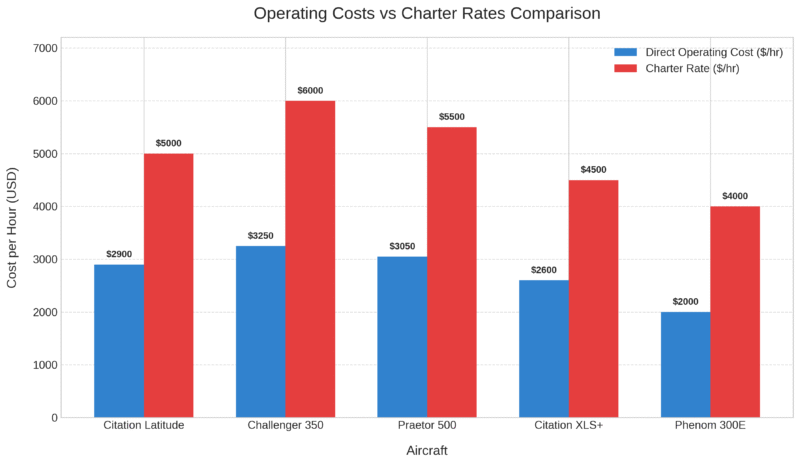
| Aircraft | Direct Operating Cost (per hour) | Typical Charter Rate (per hour) | Acquisition Cost (New, ₹ Crore) | Fuel Burn (Litres/Hour) |
|---|---|---|---|---|
| Cessna Citation Latitude | ₹2.25 – 2.55 Lakh | ₹3.70 – 4.55 Lakh | 140 – 155 | 795 – 870 |
| Bombardier Challenger 350 | ₹2.50 – 2.90 Lakh | ₹4.55 – 5.35 Lakh | 215 – 240 | 945 – 1,020 |
| Embraer Praetor 500 | ₹2.30 – 2.75 Lakh | ₹4.15 – 4.95 Lakh | 140 – 165 | 870 – 945 |
| Cessna Citation XLS+ | ₹2.00 – 2.30 Lakh | ₹3.30 – 4.15 Lakh | 105 – 125 | 680 – 795 |
| Embraer Phenom 300E | ₹1.50 – 1.80 Lakh | ₹2.90 – 3.70 Lakh | 75 – 90 | 570 – 680 |
Key Considerations for Buyers
When evaluating midsize jets for purchase or charter, several factors should influence your decision beyond the raw performance specifications:
1. Mission Profile Analysis
Before selecting an aircraft, carefully analyse your typical flight patterns:
- Range Requirements: If your typical flights exceed 2,500 nautical miles, the Praetor 500 or Challenger 350 may be more suitable despite their higher costs.
- Airport Constraints: For operations from airports with shorter runways, the Citation XLS+ and Phenom 300E offer superior performance.
- Passenger Load: Consider both typical and maximum passenger requirements, as well as luggage needs for each passenger.
2. Total Cost of Ownership
Look beyond the acquisition price to understand the actual cost of ownership:
- Fixed Costs: Insurance, hangar fees, crew salaries, and training
- Variable Costs: Fuel, maintenance, landing fees, and catering
- Residual Value: Historical depreciation rates and market demand
- Manufacturer Support: Parts availability, service centre network, and warranty programs
3. Cabin Comfort and Amenities
For many passengers, the cabin experience defines their satisfaction with the aircraft:
- Cabin Dimensions: Consider both the physical measurements and the effective use of space
- Cabin Altitude: Lower cabin altitudes reduce fatigue on longer flights
- Noise Levels: Quieter cabins significantly improve the passenger experience
- Connectivity: Evaluate Wi-Fi capabilities and other communication systems
- Customisation Options: Some manufacturers offer more flexibility in cabin layout and materials
4. Charter Potential
If you plan to offset ownership costs through charter revenue:
- Market Demand: Some models are more popular in the charter market than others
- Charter-Friendly Features: Configurations that appeal to a broad range of clients
- Operating Economics: Lower hourly costs improve charter profit margins
- Versatility: Aircraft that can serve multiple mission types have higher utilisation rates
Ready to Explore the Right Midsize Jet for Your Needs?
Safe Fly Aviation offers personalised consultations to help you identify the perfect aircraft for your mission requirements, budget, and preferences. Our team of experts can guide you through the selection process, arrange demonstrations, and facilitate purchases or charter arrangements.
The Future of Midsize Jets
The midsize jet market continues to evolve with several trends shaping the next generation of aircraft:
Technological Advancements
Future midsize jets are likely to incorporate more advanced technologies, including:
- Enhanced connectivity solutions for seamless ground-to-air communications
- More sophisticated fly-by-wire systems for improved handling and safety
- Advanced composite materials for weight reduction and enhanced performance
- More fuel-efficient engines with reduced environmental impact
- Simplified maintenance procedures through digital monitoring and predictive analytics
Sustainability Initiatives
Environmental considerations are increasingly important in business aviation:
- Sustainable aviation fuel (SAF) compatibility and infrastructure
- More efficient aerodynamic designs to reduce fuel consumption
- Electric and hybrid propulsion systems for future models
- Carbon offset programs integrated with aircraft operations
Cabin Innovations
Passenger experience will continue to drive cabin enhancements:
- More personalised cabin environments through innovative technology
- Improved sound dampening and noise cancellation
- Advanced air purification systems
- More versatile cabin layouts for different mission profiles
- Enhanced connectivity and entertainment options
Conclusion and Recommendations
The top five best-selling midsize jets represent the pinnacle of aviation engineering, offering exceptional capabilities for private and business travel. Each aircraft has found its market niche through a unique combination of performance, comfort, and economics:
- The Cessna Citation Latitude strikes an ideal balance between cabin comfort and versatility, appealing to a diverse range of operators.
- The Bombardier Challenger 350/3500 excels with its wide-body cabin and superior range capabilities.
- The Embraer Praetor 500 pushes the envelope with cutting-edge technology and exceptional range.
- The Cessna Citation XLS+ continues to win customers with its proven reliability and favourable economics.
- The Embraer Phenom 300E offers an economical alternative with performance that rivals many midsize jets.
The “best” midsize jet ultimately depends on your specific requirements, preferences, and operating environment. By carefully analysing your mission needs and considering all aspects of ownership or charter, you can identify the aircraft that will provide the optimal combination of performance, comfort, and value for your unique situation.
At Safe Fly Aviation, our team of experienced professionals is ready to assist you with every aspect of aircraft acquisition, management, and charter. Contact us today to begin your search for the ideal midsize jet to meet your travel needs.
Explore Our Aircraft Sales and Charter Services
Whether you’re looking to purchase your midsize jet or need charter solutions for your travel needs, Safe Fly Aviation offers comprehensive services tailored to your requirements.